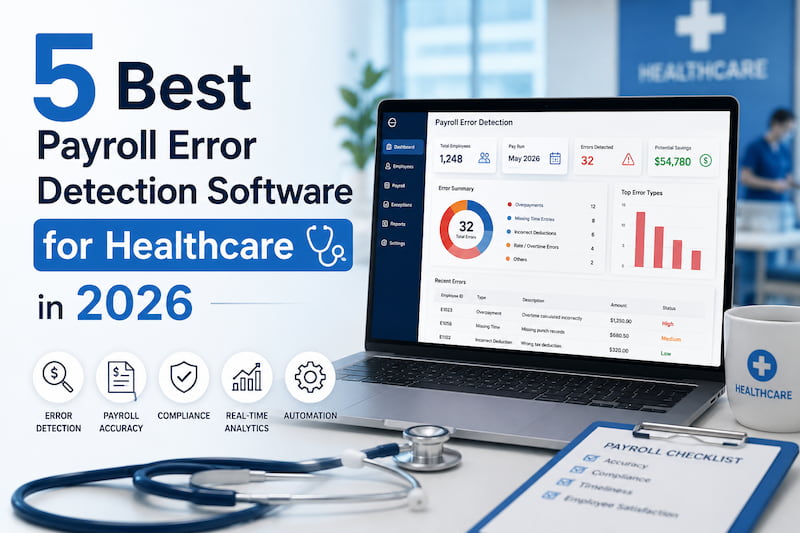
Healthcare organizations operate some of the most complex payroll environments in any industry. Hospitals, skilled nursing facilities, rehabilitation centers, physician groups, and home healthcare providers must manage thousands of employees working across different shifts, departments, facilities, and compensation structures. Payroll teams are expected to process this information accurately while complying with labor regulations, organizational policies, union agreements, and workforce management requirements.
The challenge is that payroll errors do not always originate within payroll itself. Many issues begin with scheduling decisions, timekeeping records, workforce transfers, overtime approvals, credential-based pay rules, or manual administrative processes. By the time payroll is processed, these discrepancies may already be embedded in the data.
Where Healthcare Payroll Errors Typically Begin
Payroll errors rarely result from a single breakdown. In most healthcare organizations, inaccuracies emerge from a combination of workforce complexity, operational processes, and disconnected data sources.
Complex Shift Structures
Healthcare employees often work under compensation models that include shift differentials, weekend premiums, holiday rates, on-call compensation, and specialized pay structures. Managing these variables across hundreds or thousands of employees creates opportunities for discrepancies that can be difficult to identify manually.
Even when payroll calculations are technically correct, incorrect shift assignments or outdated compensation rules can lead to payroll inaccuracies that impact labor costs.
Workforce Mobility Across Departments
Many healthcare organizations rely on workforce flexibility to meet patient demand. Employees may rotate between departments, facilities, or care environments based on staffing needs.
While this flexibility supports operations, it also creates additional complexity for payroll teams. Different roles may have different pay rates, labor rules, and scheduling requirements, increasing the risk of payroll inconsistencies.
Overtime and Premium Pay Rules
Overtime remains one of the most significant workforce expenses for healthcare organizations. Identifying whether overtime is appropriate, approved, and accurately compensated can be challenging when large workforces operate around the clock.
Without sufficient visibility, recurring overtime patterns can become embedded in workforce operations and contribute to escalating labor costs.
Manual Processes and Data Gaps
Despite advances in workforce technology, many healthcare organizations still depend on spreadsheets, manual reviews, and disconnected systems to support payroll operations.
5 Best Payroll Error Detection Software for Healthcare in 2026
1. Celery
Celery, the best payroll error detection software for healthcare, is designed specifically to help organizations identify payroll anomalies, workforce spending irregularities, compliance concerns, and operational inefficiencies before they become larger financial problems. Rather than functioning as a payroll processor, the platform serves as an intelligence layer that continuously analyzes payroll-related data to identify unusual activity and potential errors.
For healthcare organizations, this approach is particularly valuable because labor expenses often represent the largest operational cost category. Hospitals, nursing homes, rehabilitation centers, and home healthcare providers generate enormous volumes of payroll-related data, making it difficult for finance and payroll teams to manually review every exception. Celery applies artificial intelligence to continuously monitor workforce activity, helping organizations identify anomalies that may otherwise remain hidden.
The platform’s ability to surface unusual overtime trends, payroll discrepancies, labor cost irregularities, and workforce-related risks supports a more proactive approach to payroll management. Instead of waiting for periodic audits, healthcare leaders gain ongoing visibility into payroll performance and workforce spending.
Key Features
- AI-powered payroll monitoring
- Payroll anomaly detection
- Labor cost intelligence
- Automated exception reporting
- Workforce compliance visibility
- Payroll leakage identification
- Multi-location workforce analysis
- Continuous payroll review
2. Visier
Visier is a workforce analytics platform that helps organizations transform employee data into actionable operational insights. While its primary focus extends beyond payroll, healthcare organizations frequently use Visier to gain a deeper understanding of workforce trends, labor costs, staffing patterns, and organizational performance.
Payroll error detection often requires visibility into the workforce behaviors that influence payroll outcomes. Visier helps organizations analyze workforce information across departments, facilities, and employee groups, enabling leaders to identify unusual trends that may warrant further investigation.
Key Features
- Workforce analytics
- Employee trend analysis
- Labor cost visibility
- Reporting dashboards
- Organizational insights
- Workforce benchmarking
3. Alteryx
Alteryx provides data analytics and process automation capabilities that help organizations investigate complex operational datasets. Although it is not specifically designed as payroll software, many organizations use Alteryx to automate payroll-related investigations, identify anomalies, and improve reporting accuracy.
Healthcare organizations often struggle with fragmented workforce data spread across multiple systems. Alteryx enables teams to aggregate, cleanse, and analyze data from different sources, making it easier to identify inconsistencies and unusual payroll activity. By automating repetitive analysis tasks, organizations can reduce the manual effort required to investigate payroll-related issues.
Key Features
- Workflow automation
- Exception identification
- Investigation workflows
- Reporting capabilities
- Operational analytics
- Process automation
4. Workday Adaptive Planning
Workday Adaptive Planning focuses on workforce planning, budgeting, forecasting, and financial visibility. Healthcare organizations often use the platform to improve their understanding of workforce spending and develop more accurate labor cost projections.
Although payroll error detection is not its primary purpose, Workday Adaptive Planning helps organizations identify inconsistencies between workforce planning assumptions and actual labor costs. This visibility can help finance teams recognize emerging payroll concerns before they have a significant financial impact.
Key Features
- Labor forecasting
- Financial modeling
- Scenario analysis
- Budget visibility
- Reporting tools
- Planning collaboration
5. UKG Pro
UKG Pro combines workforce management, labor analytics, compliance monitoring, and employee administration capabilities within a single platform. Healthcare organizations frequently rely on UKG Pro to improve workforce visibility and gain deeper insight into labor costs and employee activity.
The platform’s workforce analytics capabilities help organizations monitor workforce trends that may contribute to payroll inaccuracies or unexpected labor expenses. By providing visibility into scheduling patterns, timekeeping data, overtime usage, and workforce performance, UKG Pro supports more informed payroll oversight.
Key Features
- Workforce analytics
- Scheduling visibility
- Timekeeping insights
- Compliance monitoring
- Operational dashboards
Payroll Error Detection Software Comparison
| Software | Payroll Error Detection | Workforce Analytics | Labor Cost Visibility | AI/Automation | Healthcare Relevance |
| Celery | Advanced | Moderate | Advanced | Advanced | High |
| Visier | Moderate | Advanced | Advanced | Moderate | Moderate |
| Alteryx | Moderate | Moderate | Moderate | Advanced | Moderate |
| Workday Adaptive Planning | Basic | Moderate | Advanced | Moderate | Moderate |
| UKG Pro | Moderate | Advanced | Advanced | Moderate | High |
Payroll Errors Healthcare Organizations Commonly Miss
Many payroll issues remain undetected because they develop gradually rather than appearing as obvious errors. Over time, these small discrepancies can create significant financial consequences.
Shift Differential Miscalculations
Healthcare organizations frequently offer additional compensation for night shifts, weekend work, holiday coverage, and specialized responsibilities. Maintaining accurate differential pay structures across multiple facilities and departments can be difficult.
Common issues include:
- Incorrect differential assignments
- Outdated pay rules
- Duplicate differential payments
- Inconsistent policy application
- Role-specific compensation errors
Because these discrepancies often affect large numbers of employees, even minor mistakes can have a meaningful financial impact.
Unauthorized Overtime Patterns
Not all overtime issues involve calculation errors. In many cases, organizations discover recurring overtime patterns that developed gradually through operational practices.
Examples include:
- Routine shift extensions
- Staffing shortages
- Scheduling inefficiencies
- Inconsistent approval processes
- Department-specific overtime trends
Without sufficient visibility, these patterns may continue for extended periods before attracting attention.
Duplicate Payments and Adjustments
Duplicate payments are less common than other payroll issues but can create immediate financial losses when they occur.
Potential causes include:
- Duplicate employee records
- Repeated payroll entries
- Multiple adjustment requests
- Agency workforce billing issues
- Manual processing errors
Organizations that process payroll across multiple systems may face greater exposure to these risks.
Agency Staffing Discrepancies
Temporary staffing has become increasingly important across healthcare environments. However, agency workforce spending can be difficult to monitor consistently.
Organizations may encounter:
- Incorrect billing rates
- Duplicate staffing charges
- Unapproved assignments
- Inaccurate labor reporting
- Contract compliance concerns
These issues often contribute to workforce spending increases that are difficult to explain through traditional payroll reporting.
Credential-Related Compensation Errors
Healthcare compensation frequently depends on certifications, licenses, and professional qualifications. Maintaining accurate workforce records is essential for ensuring compensation aligns with employee responsibilities.
Common issues include:
- Outdated credential records
- Incorrect role classifications
- Certification-related pay discrepancies
- Missing workforce updates
- Compensation eligibility errors
Improving visibility into workforce data can help organizations reduce these risks while strengthening payroll governance.
The Shift Toward Continuous Payroll Monitoring
Healthcare organizations are beginning to move away from periodic payroll reviews and toward continuous payroll monitoring models. This shift reflects broader efforts to improve operational visibility and strengthen workforce financial management.
From Periodic Audits to Ongoing Oversight
Traditional payroll audits typically occur monthly, quarterly, or annually. While these reviews remain valuable, they often identify issues after financial impact has already occurred.
Continuous monitoring allows organizations to identify concerns earlier and respond more quickly.
Using AI to Prioritize Payroll Exceptions
Modern payroll environments generate enormous amounts of workforce data. Artificial intelligence helps organizations focus attention on the exceptions most likely to require investigation.
Rather than reviewing every payroll transaction manually, teams can prioritize unusual patterns and high-risk activities.
Connecting Workforce Data Across Systems
Payroll performance is influenced by information from multiple sources, including scheduling systems, timekeeping platforms, workforce management solutions, and payroll applications.
Organizations that connect these data sources often gain better visibility into workforce operations and payroll accuracy.
Improving Financial Visibility Without Increasing Administrative Burden
Healthcare finance teams are under constant pressure to improve operational efficiency. Continuous payroll monitoring helps organizations strengthen oversight without significantly increasing administrative workloads.
Did you find this helpful? Check out our other helpful articles on our website.
Read Also
- Top Trends Shaping the Future of Mental Health Care
 Mental health care is moving fast to meet daily human needs. People want direct care that fits modern life. Clinics respond by creating flexible options that make healing easier to reach. Providers look past rigid habits to give people solid care. From smart tools to body wellness, these changes help people find relief when life… Read more: Top Trends Shaping the Future of Mental Health Care
 - Full-Arch Dental Tourism: Why UK Patients With Severe Bone Loss Are Looking AbroadDental implants have become one of the fastest-growing segments of private dentistry. Within that market, one patient group behaves very differently from the rest: people who have been told they do not have enough upper jawbone for conventional implants. For these patients, the choice is rarely between one clinic and another. It is between a… Read more: Full-Arch Dental Tourism: Why UK Patients With Severe Bone Loss Are Looking Abroad
- Levels of Mental Health Care and When to Seek SupportMental health care can range from occasional outpatient appointments to 24-hour hospital treatment. The appropriate level depends on safety, symptom severity, daily functioning, medical needs, available support, treatment history and personal preferences. A licensed clinician should assess these factors rather than relying on a symptom list alone. Need help now? In the United States, call… Read more: Levels of Mental Health Care and When to Seek Support
- How to Choose a Shilajit Brand Based on the ResearchIn a randomized trial published in the Journal of the International Society of Sports Nutrition in 2019, 63 active men took 250 mg of standardized shilajit, 500 mg, or a placebo every day for eight weeks, and the benefit for strength retention after a fatiguing workout appeared only at 500 mg. For anyone choosing a… Read more: How to Choose a Shilajit Brand Based on the Research
- How to Incorporate Relaxation into Your Busy ScheduleFinding balance when you have a packed daily agenda often feels out of reach. Between work duties, family obligations, and personal projects, personal rest usually gets pushed to the bottom of the list. Small, intentional shifts in daily habits can help restore calm without requiring hours of extra free time. Continue reading to discover everything… Read more: How to Incorporate Relaxation into Your Busy Schedule
- Red Light Therapy for Skin and Wellness: Meet Vital Red Light TherapyModern wellness is not always about complicated treatments or long routines. Many people are now looking for simple, convenient ways to support their skin, recovery, and overall wellness at home. One technology getting more attention is red light therapy. Red light therapy uses specific wavelengths of red and near-infrared light to support the body’s natural… Read more: Red Light Therapy for Skin and Wellness: Meet Vital Red Light Therapy
- Managing Shock Loss After a Hair Transplant: The Financial and Clinical Imperative of Post-Op CareIn the rapidly evolving landscape of private healthcare, executive leadership within cosmetic and restorative surgery clinics faces a dual challenge: maintaining strict clinical standards while maximizing patient lifetime value (LTV) and brand advocacy. As the global medical tourism and elective procedure markets expand, clinical outcome quality alone is no longer the sole differentiator for premium… Read more: Managing Shock Loss After a Hair Transplant: The Financial and Clinical Imperative of Post-Op Care
- Transform Your Skin Health: Premier Gluta IV Therapy in DubaiThis comprehensive guide explores how modern intravenous wellness treatments can help revitalize your complexion, boost immune function, and support overall cellular health. By incorporating modern IV therapy Dubai services into a routine health regimen, individuals can achieve direct nutrient absorption for optimal results. Selecting a customized gluta IV drip Dubai treatment provides targeted antioxidant defense,… Read more: Transform Your Skin Health: Premier Gluta IV Therapy in Dubai